
Writmont whitepaper
Bounded accounts for AI agents on Solana
Abstract
Writmont gives every AI agent on Solana one key, one balance, and a Writ: a spending policy that only the agent’s owner can change.
Behind the key sits a cost-aware router. It measures models continuously on agent tasks and sends each request to the most efficient model that meets the quality bar the owner set. Every call leaves a receipt, and each hour the receipts are committed to Solana, so an agent’s history can be verified by anyone.
The $WRIT token launches on pump.fun as a fair launch: 1,000,000,000 tokens, no team allocation, no presale, no vesting. Trading fees fund the build-out of Writmont and daily usage credits for holders. A fixed share of platform fees buys back and burns $WRIT.
Why now
Agents have become the main buyers of AI, and Solana has become a payment rail built for them.
- Agents now generate 76% of the AI tokens processed on the largest multi-model API marketplace, up from 8% a year earlier (Decrypt).
- The Solana Foundation has launched a hub for more than 120 teams building AI products on the network, alongside new payment tools for agents (same source).
- The x402 standard lets an agent pay for a service per request in USDC on Solana, with no account and no card.
Agents can now earn, spend and pay on their own. What they lack is an account built for that.
The problem
An agent that spends money without a human approving each call breaks three things: cost, control and record.
- Cost. The same task can cost a fraction of a cent or several dollars depending on the model. Model prices differ by two orders of magnitude (FrugalGPT), and choosing the right one for every call by hand is not practical.
- Control. An agent that holds a key or a wallet can overspend, loop, or be talked into paying. On 22 February 2026 an agent sent 52.4 million tokens, about $250,000, to a stranger who replied to it with a sad story (Solana Compass). Limits have to live outside the agent.
- Record. An agent leaves no history that a client, a lender or another agent can check. Screenshots of spend and earnings prove nothing.
Our vision
Intelligence gets cheaper every quarter, while bounded authority and a verifiable record stay scarce. Writmont is built on four convictions.
- Every call should go to the most efficient model that does the job well. Cost-aware routing can match a top model’s quality at a fraction of its cost: FrugalGPT matched the best single model’s quality with up to 98% lower cost (arXiv 2305.05176), and RouteLLM cut costs by more than 2 times in some cases without losing quality (arXiv 2406.18665).
- Limits are the product. Owners will send agent traffic through whatever enforces limits the agent cannot loosen, because one bad loop costs more than a year of fees.
- Records compound. Each receipt adds to an agent’s history, and history is what a client or lender checks before trusting an agent.
- A token with no insiders earns trust only through flows that run on their own and can be seen by anyone.
How Writmont works
Writmont has four parts: the Writ, the router, the account with its payments, and the receipt log. A gateway enforces the Writ on every call before any model or payment is reached.
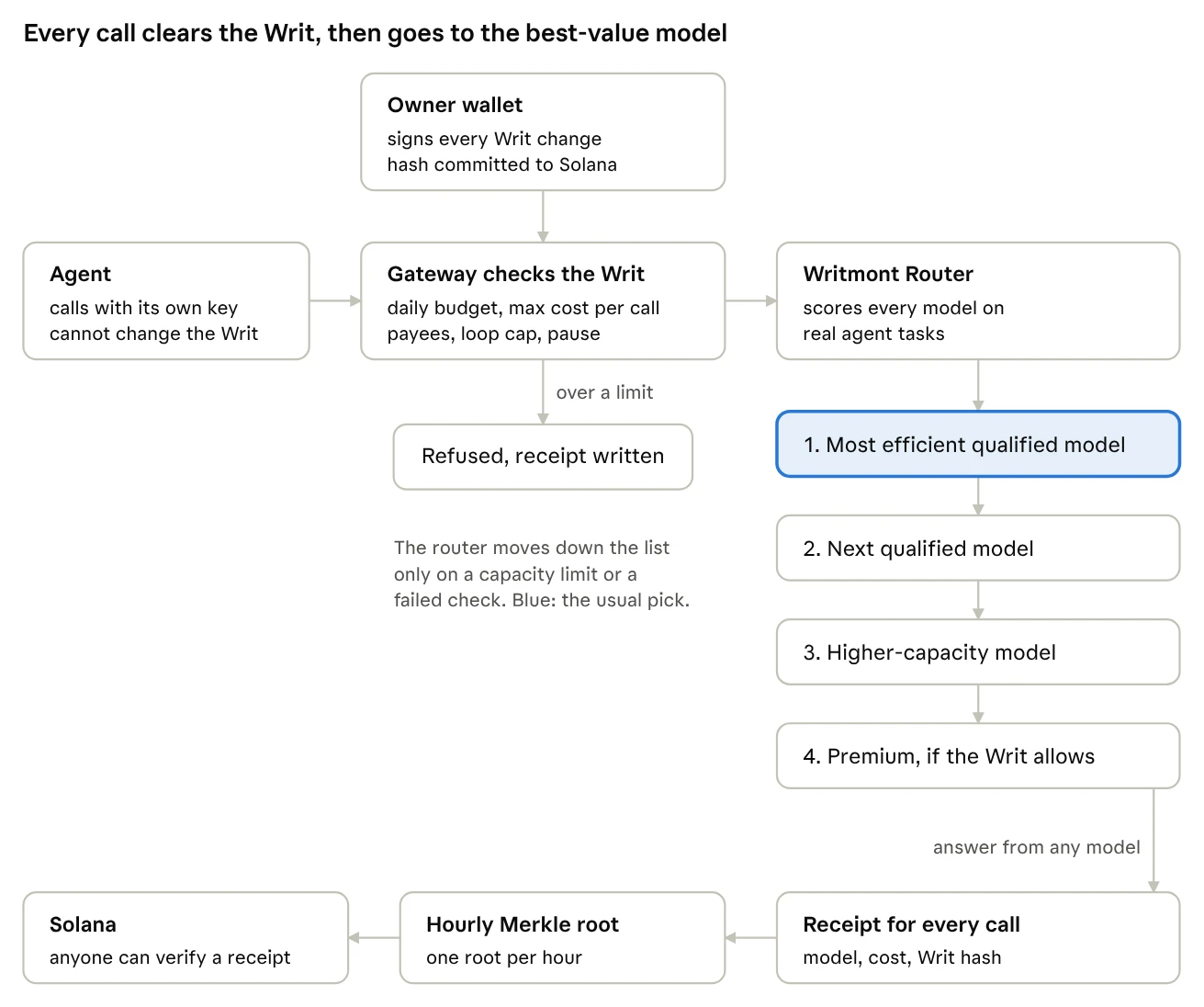
A call that breaks the Writ stops at the gateway and still leaves a receipt. A call that passes goes to the model that gives the best value for its task, and every answer is recorded.
The Writ
A Writ is a versioned policy signed by the owner’s wallet. The agent’s key can spend inside it but cannot change it, and every change is hashed to Solana.
| Field | Example | What it does |
|---|---|---|
daily_budget |
$5.00 | Hard stop across models, tools and payments |
max_cost_per_call |
$0.05 | Refuses any call quoted above it |
quality_bar |
per task class | The minimum quality the router must meet |
model_tiers |
standard | Premium models only when the owner allows them |
data_policy |
strict | Excludes providers that store or train on prompts |
payees |
allowlist | Payments only to listed services |
max_iterations |
25 per session | Stops an agent stuck in a loop |
paused |
false | One switch stops the agent and every sub-agent |
The router
The Writmont Router decides which model answers each call, and it decides on evidence.
- Measure. Every model in the pool runs a private benchmark of agent tasks: summarising, extracting structured data, calling tools, classifying, fixing code and reasoning. Each model gets a score per task class, refreshed weekly and whenever its behaviour shifts.
- Watch. Success rate, latency and capacity are tracked per model in real time. A failing model leaves the rotation automatically.
- Classify. Each request is labelled by task class and by what it needs: tools, structured output, vision, long context.
- Choose. The router picks the most efficient model that clears the Writ’s quality bar for that class, within budget.
- Fall back. A capacity limit or a failed output check moves the call to the next qualified model, never above the Writ’s cost cap.
- Show. Every response names the model that answered, its cost and its receipt id.
In formal terms, for a request r of task class k under Writ w, the router picks
m*(r) = argmin over m in M of c(m, r)
        subject to  q̂(m, k) ≥ q_min(k, w)  and  h(m) = 1
where c is the expected cost of model m, q̂ its measured quality on class k, q_min the bar set by the Writ and h its live health. Builders call writmont/auto for efficiency first or writmont/best for quality first within budget.
At launch the router serves an efficiency-focused model pool. Launch proceeds expand it with premium frontier models, as set out in the Roadmap.
Account and payments
- Sign in with a Solana wallet, or with email for builders without one.
- Top up in USDC. One credit pays for $1 of usage at list price, and a failed call refunds its credits.
- Agents can also pay per request with x402 in USDC, with no account.
- Each sub-agent gets its own key and Writ, funded from its parent.
- Access through an OpenAI-compatible endpoint and a hosted MCP server.
Receipts
Every call writes a receipt: agent id, time, model, cost and Writ hash. Prompts and outputs are never stored in it. Each hour the receipts are hashed into one Merkle root and written to Solana, so anyone holding a receipt can prove it was included. Daily statements per agent are built from the same receipts.
The $WRIT token
$WRIT is a fair-launch token on pump.fun. Everyone who buys it is chipping in to build Writmont, and gets usage credits and lower fees back.
| Item | Setting |
|---|---|
| Supply | 1,000,000,000 $WRIT, minted once by pump.fun |
| Distribution | 100% through the pump.fun bonding curve: no team allocation, presale, vesting or treasury |
| Team purchases | Made on the curve like anyone else, with the wallets disclosed |
| Creator fees | Split between two public wallets: 50% to the Build fund (development, premium model capacity, security audits) and 50% to holder credits |
| Buyback | 25% of net platform fees buy back and burn $WRIT automatically on pump.fun |
| Staking | None. Holding is enough |
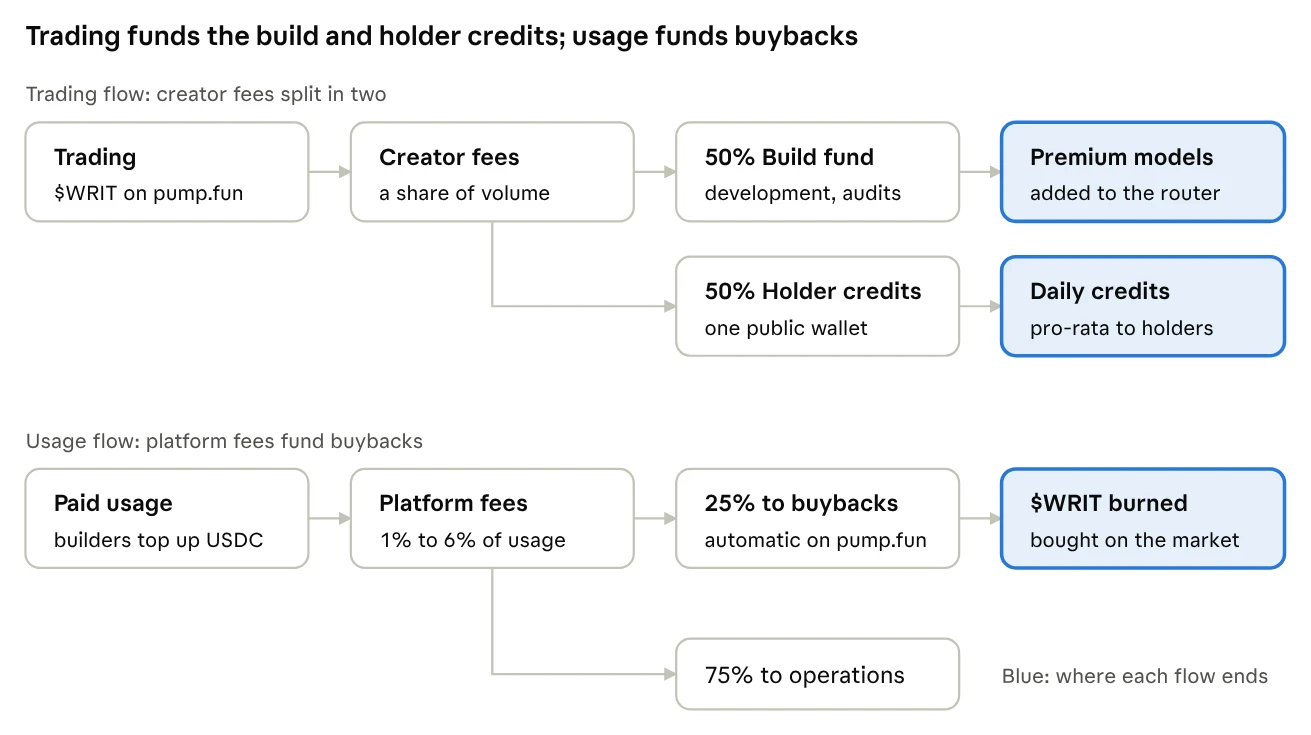
No flow needs a treasury or a vote. Every wallet in it is public, so anyone can check where each fee went.
What holding $WRIT does
Holding unlocks a share of the daily holder credits and a lower platform fee. Balance is measured as the lower of today’s balance and the 7-day average, summed over the owner’s wallet and its agents’ wallets.
| Time-weighted balance | Share of supply | Platform fee on usage | Daily credits |
|---|---|---|---|
| Under 100,000 | under 0.01% | 6% | None |
| 100,000 or more | 0.01% | 4% | Pro-rata share |
| 1,000,000 or more | 0.1% | 2% | Pro-rata share |
| 10,000,000 or more | 1% | 1% | Pro-rata share |
Each day’s credit pool P equals the creator fees the holder-credits wallet received the day before, and nothing more. Wallet i receives
a_i = P × w_i / Σ w_j, where w_i = min(b_i, 7-day average of b_i)
There is no per-wallet cap, so splitting a balance across wallets gains nothing, and the 7-day average stops borrowed balances from counting. Fee levels are a starting proposal and will be published before launch.
What $WRIT is not
$WRIT is not a share in Writmont and pays no cash. Credits are for using Writmont: they cannot be transferred, sold or redeemed, and unused credits return to the pool. Buybacks are funded only from fees Writmont has already earned.
Roadmap
Each phase builds on the one before it, and the Build fund from the launch pays for Phase 2.
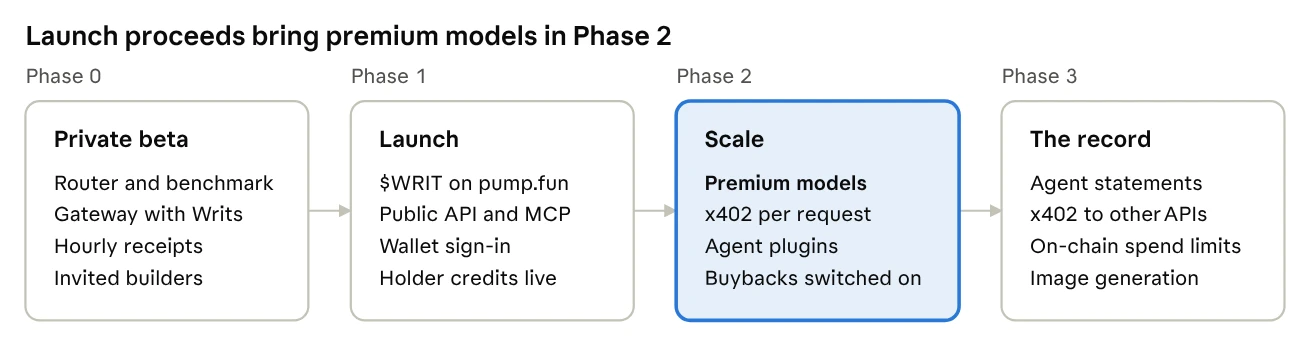
Dates are announced at the start of each phase.
Risks
Writmont is early-stage software, and anyone using it or holding $WRIT should weigh these risks.
| Risk | What could happen | How Writmont responds |
|---|---|---|
| Model providers | Providers change prices, capacity or terms | Many providers in the pool and automatic fallback, so no single provider is critical |
| Security | A breach or bug in the gateway costs users money | Encrypted keys, external audits paid from the Build fund, Writ hashes on Solana, on-chain spend limits later |
| Credit farming | Wallets split balances to collect more credits | Proportional credits that splitting cannot game, a minimum holding, time-weighted balances |
| Token volatility | Trading volume and price fall after launch, shrinking the credit pool | The product does not depend on the pool; credits scale with real fees only |
| Launch platform | pump.fun changes its fee rules or buyback tools | Manual buybacks from a published wallet with a public log |
| Regulation | Prepaid balances or the token draw regulatory attention | Legal review before launch; the token pays no cash and is not a share |
| Competition | Larger teams build similar agent accounts | The receipt history and the Writ format compound over time |
References
- Lingjiao Chen, Matei Zaharia, James Zou: FrugalGPT, arXiv 2305.05176
- Isaac Ong and others: RouteLLM, arXiv 2406.18665
- Decrypt: Solana bets big on AI agents
- Solana: x402 for AI agents
- Solana Compass: why agents need code-level permissions
Disclaimer
This paper describes a product under development. It is not an offer to sell securities or a promise of returns. $WRIT is not a share in Writmont and pays no cash; holding it gives usage credits and lower fees only. Fee levels and splits may change before launch and will be published first.